


Complaints
Head complaints
Do you suffer from a nagging pressure in your head? Do you feel stabbing pains at the sides or pain on the top of your head? Do you find yourself feeling dizzy or light-headed when you stand up? Headaches are common and can significantly affect your work, exercise and sleep. With the right guidance and physiotherapy, recovery is certainly possible. On this page, you can read about exactly what headaches are, what the possible causes are and how to tackle them effectively.
What are head complaints?
Head complaints are discomforts in and around the head, neck and the muscles of the shoulders and jaw. You may feel pain locally on the skull, at the back of the head or between the shoulder blades with pain radiating towards the head. Sometimes it is tension headache that feels like a tight band around the head. In other cases, the sinuses may be involved during a cold or allergies. Dizziness and feeling light-headed can occur together with pressure in the head due to muscle tension, breathing patterns or irritation originating from the neck and upper back.
Symptoms of head complaints
- Pressure in the head or dizziness, feeling light-headed when standing up.
- Sharp pain on the right or left side of the head, pain in the head and ear, or stabbing pain on the side of the head.
- A painful spot on the head without having bumped it, sensitivity when touching the muscles of the head and neck.
- Difficulty sleeping due to restlessness in the head and a feeling of mental overload.
- Sinus-related symptoms causing pressure in the head, especially when bending over or coughing.
Do you recognise these symptoms? Have them assessed in time. Early intervention often leads to a faster recovery.
Causes and risk factors
Long hours behind a screen with elevated shoulders and few breaks can contribute to head complaints. Muscle tension in the neck and upper back caused by stress and shallow breathing is another common factor. Mental overload can lead to poor sleep and increased sensitivity to stimuli. An unsuitable pillow that does not properly support the neck can also play a role. Jaw tension from clenching or grinding the teeth may contribute as well. Sinus problems can create pressure sensations in the head.
Less commonly, symptoms may be caused by conditions that fall outside the scope of physiotherapy, such as a cyst in the head, fluid buildup in the brain or other neurological disorders. When necessary, we will refer you to a physician who may request further assessment or an MRI scan of the head.
What can you do yourself?
- Change your posture every thirty minutes and consciously relax your shoulders.
- Focus on slow exhalation and allow your rib cage to relax to reduce tension.
- Apply heat to the neck and upper back and follow this with gentle movement.
- Use a pillow that keeps your neck in a neutral position and sleep on your side or back.
- Take short walking breaks and follow the 20-20 rule by regularly looking away from your screen.
- If pressure in the head worsens or you frequently feel light-headed when standing up, schedule an assessment.
Exercises that may help
- Shoulder blade activation: Sit upright. Gently pull your shoulder blades down and together. Hold for three seconds and relax. Repeat ten times.
- Neck rotation and side bending within a comfortable range: Slowly turn your head left and right. Then bring your ear towards your shoulder without forcing the movement. Repeat ten times in each direction.
- Upper back mobility over a rolled towel: Place a rolled towel under the middle of your back. Gently extend over the towel while exhaling. Repeat ten times.
- Chin tucks: Gently pull your chin backwards as if creating a double chin. Hold for two seconds and repeat ten times to improve neck posture.
These stretching exercises can help reduce muscle tension in the upper back and decrease pressure in the head. Perform them slowly and continue breathing normally throughout.
Scalp and skin-related symptoms
Sometimes symptoms originate more from the scalp itself. Conditions such as scalp eczema can cause itching and sensitivity. Scalp psoriasis may lead to flaking and a tight sensation. Warts on the scalp should be assessed by a general practitioner or dermatologist. Physiotherapy can help address tension, posture and comfort but does not directly treat skin conditions.
Assessment and treatment at De Fysio Man
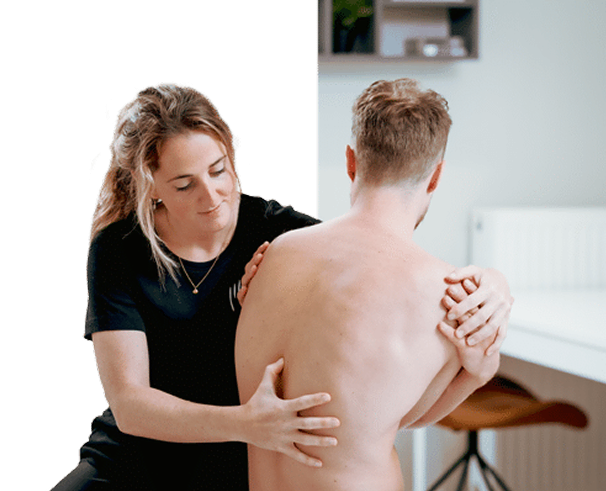
We begin with a detailed assessment and listen carefully to your story. We evaluate posture, breathing patterns and muscle tension in the head, neck and shoulder region. We assess the mobility of the spine and ribs, jaw tension and the sensitivity of muscle attachments. This helps us determine what is triggering your symptoms.
A treatment programme may include:
- Exercise therapy to improve mobility, strength and coordination of the neck and upper back
- Breathing and relaxation techniques to reduce pressure in the head
- Mobilisation and soft tissue techniques for the neck, ribs and jaw when required
- Advice on work posture, sleeping position and pillow selection
- A home exercise programme with measurable goals so you remain in control of your recovery
If we identify warning signs or suspect a cause outside our field of expertise, we will involve your general practitioner. Medical imaging such as an MRI scan of the head can only be requested through a physician.
When to seek immediate medical attention
- A sudden and severe headache that develops within seconds or is accompanied by fever, neck stiffness, speech problems or visual disturbances.
- Headache combined with weakness, loss of function or persistent confusion.
- Symptoms following a head injury, especially when accompanied by ongoing nausea or drowsiness.
- Unexplained neurological symptoms or rapidly increasing pressure in the head.
In these situations, contact your general practitioner or emergency medical service immediately.
Your next step
Do not continue living with pressure, sharp pains or tension in your head. With a clear diagnosis and a structured treatment plan, you can regain peace of mind and confidence in movement and sleep.
Schedule an appointment with De Fysio Man today and work together with us towards a calm, strong and symptom-free head and neck.
Frequently Asked Questions
This is often associated with tension headaches. Muscles in the head, neck and shoulder girdle are holding too much tension. Through breath control, posture and targeted exercises, the pressure is relieved and the tightness gradually disappears.
A dizzy, throbbing sensation in the head is often caused by stress, breathing issues or neck problems. If the symptoms become more severe, or if you experience double vision, loss of consciousness or vomiting, or if you feel light-headed when standing up and are at risk of fainting, please contact your GP.
Only if there are indications of conditions outside the musculoskeletal system. In such cases, your GP will refer you. For most common complaints, a tailored exercise and posture plan is more effective than imaging.

Share this article:


Take the first step towards recovery today
Do not continue to endure discomfort. With a personalised treatment plan, we can assist you in making rapid and effective progress.

Share this article: